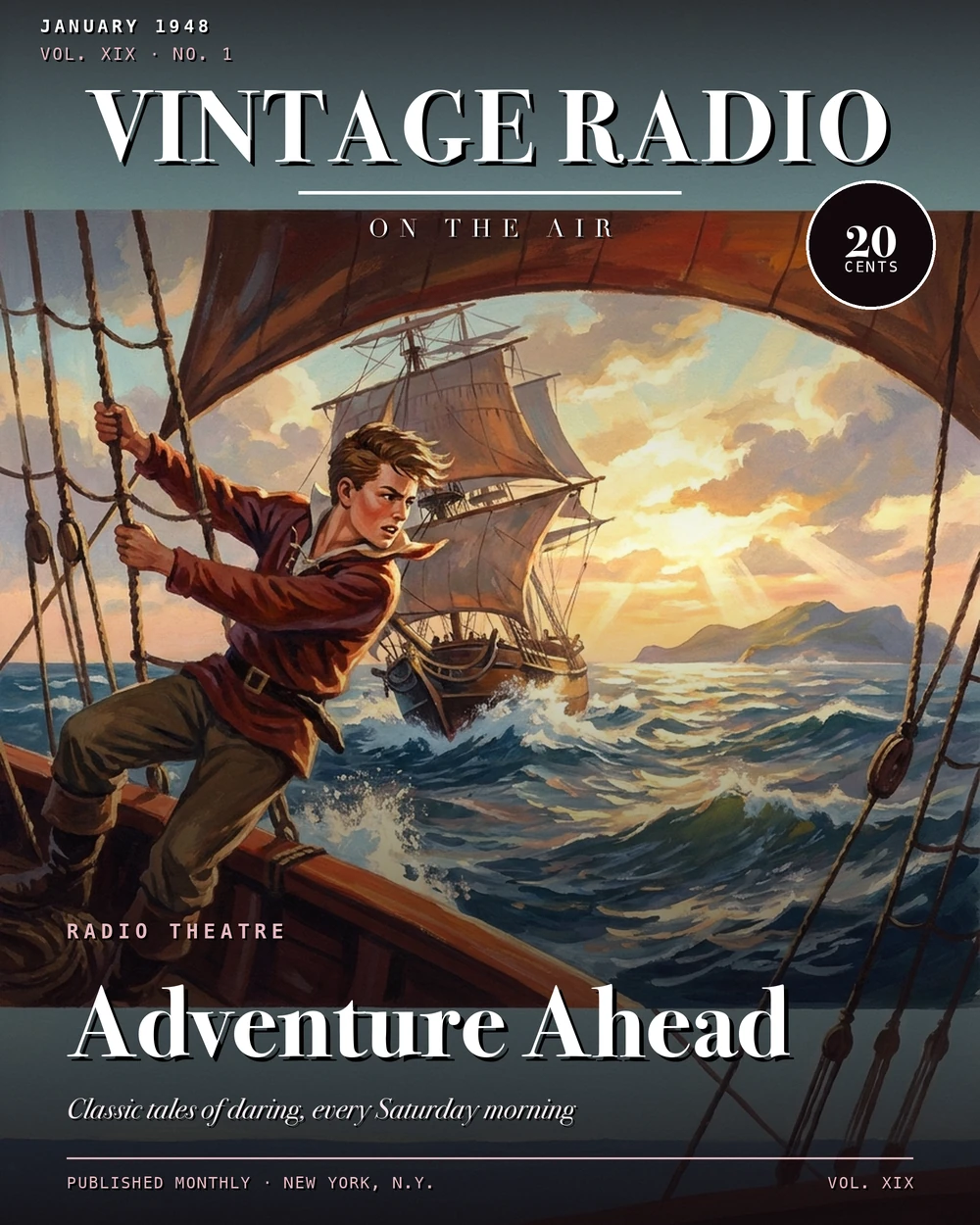
Adventure Ahead
A Summer Show for Boys Coming of Age
Adventure Ahead had a specific audience in mind from the start. NBC conceived it not for small children but for older boys on the edge of adulthood — the kind of kid who had already worked through the usual juvenile fare and was ready for something with a bit more weight. The network billed it officially as "famous stories for young people," but the content made no secret of who it was really aimed at. There were no female protagonists, no love interests, no female mentors of any kind. This was adventure in the classic mold: men and boys doing dangerous things in the world.
The series premiered on August 5, 1944, airing Saturday mornings on NBC Red from 10:30 to 11:00. It ran as a summer replacement, and its full broadcast run came to 14 episodes before NBC Red preempted its schedule for the Sixth War Loan Drive broadcast on November 11, 1944, cutting the series short before it might otherwise have continued.
What It Adapted and Where the Stories Came From
The most distinctive thing about Adventure Ahead was its source material. Rather than building original stories around recurring characters — the approach taken by programs like Captain Midnight or Terry and the Pirates — Adventure Ahead worked as a pure anthology, adapting a different piece of fiction each week. The literary range was genuinely wide. Daniel Defoe's Robinson Crusoe appeared alongside Stephen Vincent Benét's short story "A Tooth for Paul Revere." G. A. Henty's Victorian adventure novel One of the 28th got an episode, and so did John Buchan's Greenmantle and Alexander Dumas's The Three Musketeers, which served as the 14th and final broadcast on November 4, 1944.
Not all the sources were canonical classics. Hubert Skidmore's "Hill Lawyer" made the schedule, as did work by Waldo Fleming. "Toby Tyler or Ten Weeks with the Circus" traced the circus career of Charles Sherwood Stratton — the man known as General Tom Thumb — from performing for European royalty to meeting President Abraham Lincoln. The eclectic mix kept the show from feeling like a straightforward literature class, even if some of the episodes drew directly from the school reading list.
The range of settings matched the range of sources. A couple of episodes — "Greenmantle," "Inside the FBI" — pushed into international intrigue and wartime espionage, but most went elsewhere: sea voyages in Robinson Crusoe and Two Years Before the Mast, frontier law in "Hill Lawyer," circus life in "Toby Tyler," small-town America in "The Biscuit Eater" and "Story of a Bad Boy," colonial New England in "A Tooth for Paul Revere." The show did not have a single consistent mood so much as a consistent ambition: each week, a different world.
The Production Team and How It Sounded
Directors John Mansfield and Herbert Rice oversaw the series through its run. Sound design was treated as a genuine production element, with each episode using audio craft to build the atmosphere its story required — the creak of a sailing ship, the chaos of a circus, the tension of a wartime operation. For a program aimed at boys who might have been reading these same stories in book form, getting the sound right was part of making the radio version feel like an event rather than just a recitation.
The episode "A Tooth for Paul Revere," broadcast September 9, 1944, drew a substantial cast: Roger De Koven, Kermit Murdock, John Thomas, Joseph Wiseman, Jackie Ayers, Eleanor Audley, and Jean Gillespie all appeared in that single installment. The "Greenmantle" episode, broadcast October 28, 1944, starred Alexander Scourby in a story about British Secret Service agents working against a Nazi plot — a storyline that would have landed with obvious contemporary weight in the autumn of 1944.
The "Inside the FBI" episode came with a notable endorsement: it was reportedly approved by J. Edgar Hoover, who actively sought out popular media that could shape the values and attitudes of American youth. That kind of official backing wasn't unusual for wartime radio, but it does say something about how NBC positioned the show — as something parents and institutions could endorse, not just something kids would enjoy.
Fourteen Episodes, Eleven Survivors
Adventure Ahead ran 14 episodes in total. Eleven of those survive in circulation; the other three are lost. The surviving recordings were certified as properly identified and labeled in a release dated December 10, 2012 — a step that matters when working with decades-old transcription discs and tape copies that sometimes carry incorrect titles or dates.
The show sits in reasonable company for what it was. Programs like Adventures of Sea Hound, Jerry at Fair Oaks, Speed Gibson, and Terry and the Pirates were doing comparable work for similar audiences during the same period. Adventure Ahead was more literary in its approach than most of them, which may partly explain why it remained a summer replacement rather than earning a permanent berth. It was ambitious in a quiet way — trusting its young audience to follow along with Dumas and Buchan and Benét without needing the stories simplified beyond recognition.
What it delivered across those fourteen weeks was a condensed tour of adventure fiction across several centuries and as many continents: pirates and circuses and FBI agents and secret service operatives and colonial silversmiths, all wrapped in Saturday morning radio. The Sixth War Loan Drive ended it before anyone had decided whether it would continue, which gives the series a somewhat accidental quality as a historical artifact — a show that existed for one summer, did what it set out to do, and stopped.